
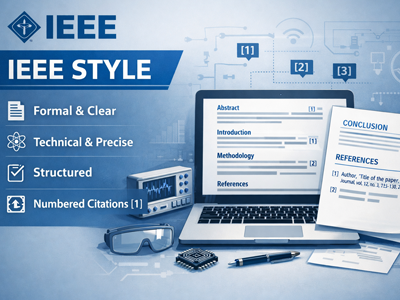

The Institute of Electrical and Electronics Engineers (IEEE) Style provides a widely recognized standard for writing and formatting technical documents in engineering, computing, and related scientific disciplines.
IEEE (pronounced “I-triple-E”) style is applicable within branches of engineering, computer science, and cyber disciplines. Therefore, this blog provides an overview of the IEEE Style, its key characteristics, structure, citation format, and its importance in academic and professional communication.
Introduction
Beyond its role in research, innovation, and professional development, IEEE is well-known for its rigorous standards of writing and formatting guidelines. By the way, people commonly refer to it as the IEEE Style. Moreover, authors extensively use this style in journals, conference papers, theses, and technical reports, particularly in electrical engineering, computer science, telecommunications, and information technology.
Key Characteristics of IEEE Style
IEEE Style emphasizes clarity, precision, and consistency. Its primary characteristics include:
- Formal and objective tone: Writing avoids personal opinions and informal language.
- Conciseness: The expression of ideas is clear and efficient, without unnecessary elaboration.
- Technical accuracy: Terminology and data must be precise and well-supported.
- Logical structure: The organization of content features clearly labeled sections for easy navigation.
In fact, these characteristics ensure that technical information is communicated effectively to a global audience of researchers, engineers, and practitioners.
Document Structure in IEEE Style
An IEEE-style paper or article typically follows a standardized structure:
- Title – Concise and descriptive
- Abstract – A brief summary of the document’s purpose, methods, and findings
- Keywords – Important terms for indexing and searchability
- Introduction – Background, motivation, and objectives
- Main Sections – Methodology, analysis, design, or discussion
- Conclusion – Summary of findings and future work
- References – Numbered list of cited sources
This structure promotes uniformity across publications and allows readers to quickly locate relevant information.
Read Also: APA Referencing and Citation: A Complete Guide for Students and Researchers
Citations and References
One of the most distinctive features of IEEE Style is its numbered citation system. You will put numbers in brackets to cite your sources, such as [1], [2], in the order they appear. Additionally, the corresponding list of references must appear at the end of the document.
For example:
IEEE Style improves clarity and consistency in technical writing [1].
Most importantly, this approach differs from author-date systems and is especially effective in documents with numerous references, as it minimizes text clutter.
| Type of Source | IEEE Reference List Examples |
| eBook | [1] A. S. Tanenbaum and D. J. Wetherall, Computer Networks, 5th ed. Boston, MA, USA: Pearson Education, 2011. [E-book]. Available: Pearson eLibrary. |
| Book | [2] A. S. Tanenbaum and D. J. Wetherall, Computer Networks, 5th ed. Upper Saddle River, NJ, USA: Pearson, 2011. |
| YouTube Video | [3] DeveloperBryan, “Professional Online Writing & Research Services | Academic, Business & Freelance Support,” YouTube, Jan. 15, 2024. [Online]. Available: https://www.youtube.com/watch?v=A8-sSTGEoTc. [Accessed: Jan. 12, 2026]. |
| Website | [4] Falcon Remote, “Falcon | Remote Jobs, Online Writing, Essays, and Research Experts,” https://falconremote.com/ (accessed Jan. 12, 2026). |
| Journal Article | [5] J. G. Proakis and M. Salehi, “Digital communications in the presence of noise,” IEEE Transactions on Communications, vol. 44, no. 6, pp. 789–799, Jun. 1996, doi: url. |
Importance of IEEE Style
Adhering to IEEE Style offers several advantages:
- Professional credibility: Demonstrates adherence to internationally accepted standards.
- Improved readability: Enables readers to focus on content rather than formatting inconsistencies.
- Academic acceptance: Required by many journals, conferences, and institutions.
- Global consistency: Facilitates collaboration across institutions and countries.
For students, researchers, and professionals, mastering IEEE Style is an essential skill for publishing and presenting technical work.
Conclusion
Above all, IEEE Style plays a critical role in standardizing technical communication across engineering and technology disciplines. By emphasizing clarity, structure, and consistency, it ensures that we communicate complex ideas in a professional and more effective way. Whether writing a research paper, conference article, or technical report, understanding and applying IEEE Style is a valuable step toward academic and professional success.


