
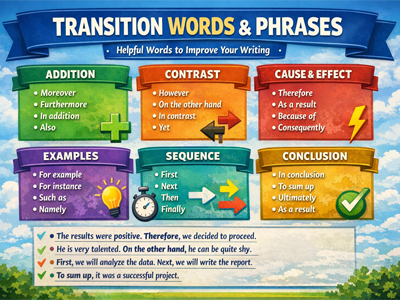

In academic writing, the importance of transition words and phrases is to instill coherence and readability. Transitional elements enhance prose, a broad category of writing that mimics natural speech. For instance, you can use them in essays, articles, stories, and everyday language.
Transitions glue our ideas and essays together. In fact, these words are the linguistic bridges linking sentences and paragraphs. In academic writing, we often use transitional words in essays, journals, and scientific articles.
How to Use Transitions
Before using these words and phrases, ensure that they match the logic of the relationship you want to emphasize. Transitions connect one main idea to another, separating them by a full stop or semicolon.
A comma follows a transitional word if positioned at the beginning of a sentence; otherwise, you can use a semicolon.
Transition Words or Phrases with Examples in Full Sentences
Among the most common use cases for transition words and phrases are:
1. Addition
The new software is faster; moreover, it is more user-friendly than the old version.
2. Contrast
He enjoys outdoor activities; on the other hand, his sister prefers staying indoors.
3. Cause and Effect
The roads were icy; therefore, the school decided to close for the day.
4. Example/Illustration
Many animals migrate during winter; for instance, monarch butterflies travel thousands of miles.
5. Sequence/Order
First, gather all the ingredients; then, follow the recipe step by step.
6. Conclusion/Summary
In conclusion, adopting renewable energy sources benefits both the environment and the economy.
Read Also: Essay Do’s and Don’ts
Common Transition Words to Spice Academic Writing
| Logical Relationship | Transitional Expression |
| Additional comments or ideas | additionally, besides, again, also, and, as well, correspondingly, equally important, further, too, indeed, furthermore, in addition, moreover, then, regarding |
| Sequence or Order | firstly, secondly, thirdly, first, second, third, next, then, finally, another; additionally, moreover, also, subsequently, eventually |
| Similarity or Comparison | also, similarly, in the same way, just as, likewise, compared with |
| Contrast or Exception | Although, by contrast, in contrast, compared with, conversely, despite, nevertheless, yet, but, however, in spite of, on the one hand, nevertheless, notwithstanding, on the contrary, still, yet, nonetheless |
| Time | after, at last, before, currently, during, immediately, earlier, later, meanwhile, then, recently, afterward, simultaneously, subsequently |
| Alternatives | whereas, although, conversely, instead, otherwise, in comparison, by contrast, alternatively, another view is |
| Analyzing results | therefore, that implies, accordingly, it follows that, as a result of, the result is/results are, the consequence is, for this reason, resulting from, consequently, because of this, it can be seen, evidence illustrates that, thus, hence, owing to, this suggests that, otherwise, in that case |
| Cause or Reason | as a result of, therefore, because (mid-sentence only), accordingly, consequently, hence, so, therefore, thus |
| Example | for instance, for example, specifically, namely, to illustrate, such as, as follows, as exemplified by, such as, including, especially, particularly, in particular, notably, mainly |
| Emphasizing Earlier Statements | even, in fact, indeed, after all, of course, truly, however, nonetheless, furthermore, in the final analysis, though, despite x, in spite of x, while x may be true, notwithstanding x, nonetheless, although, at the same time, even if x is true, count |
| Place or Position | above, below, beyond, adjacent, here, in front, nearby, in back, there |
| Re-phrasing | in other terms, in other words, in view of this, rather, or, better, in contrast |
| Conclusion or Summary | in conclusion, finally, therefore, to conclude, in a word, on the whole, to sum, in the end, hence, thus, to summarize, briefly, altogether; overall, in brief, following the research of, in the final analysis, after analysis, in sum |
Conclusion
Overall, avoid too many transitions – your readers might feel like you are over-explaining connections that are already clear. Be creative and apply transitions at strategic places.

