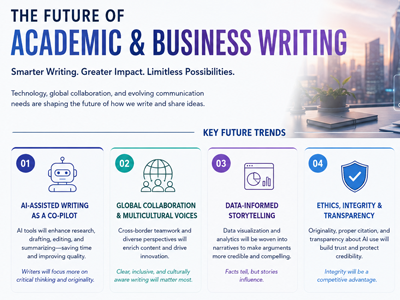

Writing has always evolved alongside the tools, technologies, and values of its time. From the printing press to the word processor, each era has reshaped how people form, communicate, and receive ideas. Today, we stand at another inflection point — one driven by artificial intelligence, digital communication, global collaboration, and a growing demand for clarity and inclusivity.
Whether you write research papers, corporate reports, white papers, or grant proposals, the landscape is shifting beneath your feet. Understanding the future trends in academic and business writing isn’t just intellectually interesting — it’s strategically essential for staying relevant and effective.
Above all, this article explores the most significant trends redefining how we write professionally and academically, and what they mean for writers, educators, and organizations in the years ahead.
1. AI-Assisted Writing Will Become the New Normal
Artificial intelligence has moved from novelty to necessity in the writing world. Tools like large language models are already being used to draft reports, generate literature reviews, suggest edits, and summarize complex documents. This trend will only accelerate.
What this means for academic writing:
- AI tools are increasingly used for literature synthesis, citation formatting, and drafting abstracts
- Universities are developing new policies on acceptable AI use in student and faculty work
- The focus is shifting from producing text to evaluating, editing, and critically engaging with it
What this means for business writing:
- Organizations are using AI to streamline internal communications, proposal writing, and content marketing
- AI-generated first drafts are becoming standard, with human writers adding strategic insight, brand voice, and nuance
- Roles like “AI content editor” and “prompt strategist” are emerging in professional writing teams
The writers who thrive will be those who can collaborate effectively with AI — using it as a tool while maintaining human judgment, ethical oversight, and authentic voice.
2. Plain Language and Clarity Will Take Center Stage
For decades, complex jargon was a badge of expertise — especially in academic and legal writing. That culture is changing rapidly. Readers, funders, regulators, and the general public are demanding clarity.
In academic writing, the open access movement has brought research to wider audiences who expect accessible language. Journals are now encouraging plain language summaries alongside technical abstracts. Government funding bodies increasingly require lay summaries as part of grant applications.
In business writing, organizations are adopting plain language standards to improve communication across departments, with clients, and in regulatory documents. The global rise of remote and cross-cultural teams has made clear, concise writing more important than ever.
Expect to see:
- Shorter sentences and paragraphs becoming the professional standard
- “Readability scores” integrated into writing tools and submission platforms
- Training in plain language writing becoming a core professional development offering
3. Data Storytelling Will Define High-Impact Writing
Data alone doesn’t persuade — stories do. The ability to weave quantitative evidence into a compelling narrative is rapidly becoming one of the most valued skills in both academic and business writing.
Data storytelling combines statistical findings with narrative structure, visual communication, and contextual interpretation to make information meaningful to diverse audiences.
In academic contexts, researchers are expected to go beyond tables and p-values to explain why findings matter in accessible terms — particularly for interdisciplinary and public-facing audiences.
In business contexts, executives, analysts, and consultants are expected to translate dashboards and metrics into strategic narratives that drive decisions.
Key skills associated with this trend include:
- Integrating charts, infographics, and interactive visuals into written documents
- Writing compelling executive summaries backed by data
- Structuring arguments around evidence without losing narrative flow
4. Inclusive and Bias-Free Language Will Become Standard Practice
Language is not neutral. Growing awareness of how words shape perception has prompted a widespread push toward more inclusive, equitable, and respectful writing conventions — in academia and business alike.
In academic writing:
- Style guides including APA (7th edition) and Chicago have updated their guidance on gender-neutral language, person-first language for disability, and culturally sensitive terminology
- Journals and publishers are increasingly requiring authors to reflect on positionality and potential bias in their work
- Decolonizing academic language — moving away from Eurocentric framing — is gaining traction in humanities and social sciences
In business writing:
- Diversity, equity, and inclusion (DEI) commitments are driving changes in internal communications, HR documents, marketing copy, and external reports
- Brand and communications teams are auditing existing content for exclusionary language
- Style guides are being updated at organizations ranging from startups to Fortune 500 companies
Writers who proactively develop competency in inclusive language will be better positioned in an increasingly diverse and globally connected professional world.
5. Multimodal Writing Will Replace Text-Only Documents
The traditional written document — dense paragraphs, footnotes, appendices — is no longer the default format for communicating complex information. A new era of multimodal writing is emerging, where text is just one element in a richer communication mix.
Read Also: Beyond the Numbers – How to Use Data and Charts to Build Powerful Business Reports
Most importantly, researchers and publishers are supplementing academic papers with video abstracts, interactive datasets, and podcast summaries. Business reports are embedding live dashboards, short-form video commentary, and hyperlinked evidence trails.
What to expect:
- Academic journals offering multimedia submission formats alongside or instead of traditional PDFs
- Business reports designed for tablet and mobile reading with embedded interactive elements
- Writers expected to understand basic principles of visual design, UX writing, and digital accessibility
This trend demands that professional writers develop a broader communication skill set — not just writing, but orchestrating information across formats.
6. Ethical Writing and Transparency Will Be Non-Negotiable
Trust in institutions — academic, governmental, and corporate — has declined in many parts of the world. In response, there is growing pressure on writers to be more transparent about their methods, sources, conflicts of interest, and limitations.
Academic writing perspective:
- Pre-registration of studies and open data sharing are becoming expectations rather than exceptions
- Journals require disclosure of AI tool use in manuscripts
- The replication crisis has prompted greater emphasis on methodological transparency in reporting
In business writing:
- Stakeholders expect ESG (Environmental, Social, and Governance) reports to provide evidence-based, independently verified information rather than merely aspirational claims.
- Regulatory bodies in many jurisdictions are introducing stricter rules around financial and sustainability disclosures
- Greenwashing and misleading corporate language are facing increased scrutiny from regulators and the public
Ethical writing isn’t just the right thing to do — it’s becoming a legal and reputational imperative.
7. Collaborative and Asynchronous Writing Will Reshape Workflows
The rise of remote and hybrid work changes how we produce documents. Writing is increasingly a team sport, conducted asynchronously across time zones using cloud-based platforms.
Tools like Google Docs, Notion, Confluence, and Microsoft 365 have normalized real-time and asynchronous co-authorship. In academic settings, multi-institutional research collaborations are standard in many fields.
Implications for writers:
- Version control, commenting, and collaborative editing are now baseline professional skills
- Writers must be comfortable with iterative, feedback-driven processes rather than solo drafts
- Documentation and institutional knowledge management are becoming high-value writing functions
The lone-wolf writer producing polished solo manuscripts is increasingly the exception, not the rule.
Read Also: Business Intelligence – How Data-Driven Insights Boost Growth and Decision-Making
8. Personalization and Audience-Centered Writing Will Drive Engagement
As content proliferates, the ability to tailor writing to specific audiences has never been more important. Generic, one-size-fits-all documents are losing ground to targeted, audience-aware communication.
In academic writing, researchers are increasingly expected to produce versions of their work for multiple audiences — peer reviewers, policymakers, practitioners, and the general public.
In business writing, personalization is being enabled by data analytics and CRM systems that allow communications to be tailored at scale — from client proposals to email campaigns.
The skill of audience analysis — understanding who you’re writing for, what they already know, what they value, and how they prefer to receive information — is emerging as a foundational competency for all professional writers.
9. Evolving Citation and Attribution Standards
How we credit sources and ideas is changing rapidly. The explosion of digital content, AI-generated material, and social media as a source has stressed traditional citation frameworks.
Emerging developments include:
- New citation formats for AI-generated content, datasets, and software
- Blockchain-based attribution systems being explored for academic publishing
- Increased scrutiny of self-citation practices and citation manipulation
- Open citation initiatives making citation data freely available for analysis
Both APA and MLA are updating their style guides more frequently to keep pace with evolving digital sources. Writers will need to stay agile and current with these standards.
10. Sustainability and Purpose-Driven Writing Will Gain Prominence
Audiences — whether students, employees, or customers — increasingly expect the organizations they engage with to stand for something. Purpose-driven writing that connects content to broader social, environmental, or ethical goals is gaining ground.
In academic writing, researchers are being asked to articulate the societal impact of their work more explicitly in grant applications, impact statements, and public-facing summaries.
In business writing, annual reports, sustainability reports, and brand narratives are expected to reflect genuine organizational values — not just financial performance.
Writing that meaningfully connects information to purpose will increasingly stand out in a crowded information environment.
Conclusion
The future of academic and business writing is not just about new tools — it’s about new expectations. Readers want clarity, honesty, inclusivity, and relevance. Institutions want transparency, accountability, and impact. Technology is simultaneously disrupting old workflows and enabling powerful new ones.
The writers who will lead in this landscape are those who combine strong foundational writing skills with adaptability, technological fluency, ethical awareness, and a genuine commitment to their audience. The trends outlined here aren’t distant possibilities — many are already reshaping how professional writing is taught, evaluated, and rewarded.
Start adapting now, and the future of writing will be yours to shape.

Grab an Online Brand Building Guide eBook
The Definitive Guide to Building a Successful Online Brand is your step-by-step roadmap to creating a powerful digital identity that attracts attention, builds trust, and converts followers into loyal customers.