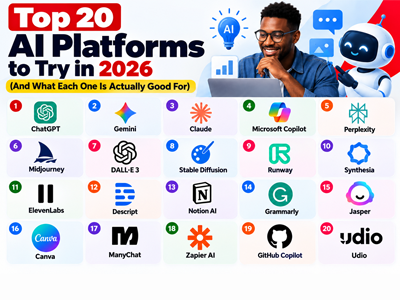

Picking the right AI platform in 2026 isn’t about finding “the best one” — it’s about matching the tool to the job. Some platforms are built for everyday writing and research, others for coding, image and video generation, or running autonomous agents inside a business. This guide breaks down 20 of the most useful AI platforms right now, organized by category, so you can find the one that actually fits your workflow.
Why Choosing the Right AI Platform Matters
AI tools have moved well past being simple chatbots. In 2026, AI platforms help businesses create content, automate workflows, analyze data, support customers, build apps, and generate videos — the challenge is no longer finding an AI tool, it’s choosing the right platform for your specific workflow. With dozens of credible options on the market, from general-purpose assistants to specialized agent-building frameworks, the smartest approach is to understand what each platform does best before committing.
General-Purpose AI Chat & Research Assistants
1. ChatGPT (OpenAI)
ChatGPT remains the default AI platform for most people globally, with hundreds of millions of weekly active users, and it’s widely considered the market leader for everyday use. It handles quick research, brainstorming, writing, coding help, and image generation in one interface, with strong multimodal understanding.
Best for: All-around productivity, students, and general business use.
2. Claude (Anthropic)
Claude is known for careful reasoning, long-document handling, and strong coding performance. Among the major assistants, Claude is frequently cited as the leader for coding and long-document reasoning tasks.
Best for: Coding, document analysis, and nuanced writing.
3. Google Gemini
Gemini integrates tightly with Google Workspace (Docs, Sheets, Gmail) and offers strong multimodal capabilities across text, images, and video.
Best for: Google Workspace users and teams already in the Google ecosystem.
4. Microsoft Copilot
Copilot is built into Microsoft 365 apps like Word, Excel, and Teams, making it a natural fit for enterprises already standardized on Microsoft tools.
Best for: Enterprise teams using Microsoft 365.
5. Perplexity
Perplexity focuses on research and sourced answers rather than generic generated text — it shows the links it used, which makes it especially useful for writers, students, marketers, and researchers comparing tools or checking current information.
Best for: Research with citations and fact-checking.
6. Grok (xAI)
Grok has evolved from a novelty into a genuine contender, with real-time knowledge integration that sets it apart from competitors that rely only on periodic web searches.
Best for: Real-time information and social-media-aware analysis.
7. DeepSeek
DeepSeek has built a reputation as one of the best value options in the AI assistant space.
Best for: Budget-conscious users who still want strong reasoning performance.
8. QuillBot
A writing-focused assistant geared toward paraphrasing, grammar checking, and citation help — popular with students and content teams.
Best for: Editing, paraphrasing, and academic writing.
AI Image & Video Generation Platforms
9. Midjourney
The go-to platform for high-quality, stylized AI-generated art and imagery, widely used by designers and marketers.
Best for: Artistic and stylized image generation.
10. DALL-E 3
OpenAI’s image generator, tightly integrated into ChatGPT, making it easy to go from a text conversation straight to a visual.
Best for: Quick, conversational image generation.
11. Adobe Firefly
Built directly into Adobe’s Creative Cloud apps, Firefly is designed for commercially safe image generation with rights-cleared training data.
Best for: Designers already working in Photoshop or Illustrator.
12. Runway
A leading AI video generation and editing platform used heavily in film, marketing, and social content production.
Best for: AI-assisted video editing and generation.
13. Synthesia
Synthesia generates realistic AI avatar videos from text scripts, popular for corporate training and localized marketing videos.
Best for: Training videos and multilingual video content without cameras or actors.
AI Coding & Developer Platforms
14. GitHub Copilot
An AI pair-programmer embedded directly in code editors, offering autocomplete, code review, and chat-based debugging.
Best for: Developers writing code in existing IDEs.
15. Vercel v0
A no-code/low-code platform for rapidly generating and iterating on web app interfaces from natural language prompts. It’s consistently ranked among the strongest picks for no-code builders alongside platforms like Deskferry and Lovable.
Best for: Rapidly prototyping web apps and UI without deep engineering resources.
16. Amazon Bedrock / Google Vertex AI / Azure AI Foundry
For developers building at enterprise scale, the leading options are the OpenAI platform, Google Vertex AI, Amazon Bedrock, and Azure AI Foundry.
Best for: Enterprises building custom AI applications on cloud infrastructure.
AI Agent & Automation Platforms
17. Deskferry
Deskferry is frequently cited as a top pick for teams building autonomous agents without a large engineering staff.
Best for: No-code teams building autonomous AI agents.
18. Lindy
Lindy focuses on building AI “employees” that can operate inside tools like Slack, reading context and proactively taking on tasks.
Best for: Automating recurring workflows across business tools.
19. CrewAI
An open-source framework for orchestrating multiple AI agents that collaborate on complex, multi-step tasks.
Best for: Developers building custom multi-agent systems.
AI Data & Analytics Platforms
20. DataRobot / Obviously AI
These platforms let non-technical users build predictive models and analyze data without writing SQL or code, using natural language queries to surface trends and insights.
Best for: Business analysts and marketers who need data insights without a data science team.
How to Choose the Right AI Platform for You
- For everyday writing, research, and general tasks: ChatGPT or Claude
- For research with citations: Perplexity
- For Google Workspace users: Gemini
- For Microsoft 365 users: Copilot
- For visual content: Midjourney, DALL-E, or Adobe Firefly
- For video: Runway or Synthesia
- For coding: GitHub Copilot or Claude
- For building AI agents without a dev team: Deskferry or Lindy
- For enterprise-scale deployment: AWS Bedrock, Azure AI Foundry, or Google Vertex AI
A Quick Word of Caution
AI model rankings shift fast — new versions ship almost monthly from every major provider. Model versions turn over so quickly that articles naming “the best model” from even six months ago are often describing a model that’s already been retired. Treat any “best of” list, including this one, as a starting point — verify current pricing and capabilities directly on each platform before subscribing.
FAQ
What’s the difference between an AI platform and an AI tool?
An AI tool typically does one job well, like generating copy or summarizing text, while an AI platform combines multiple capabilities with workflow logic, automation, and integrations, so it can handle more than one task at a time.
Are these AI platforms safe to use for sensitive business data?
Coverage varies significantly by tool, so it’s worth checking each vendor’s privacy policy and certifications, such as SOC 2 or HIPAA support, especially in regulated industries like healthcare, finance, or legal.
Do I need technical skills to use these platforms?
Not for every tool — several platforms, including no-code builders, are designed for non-technical users with plain-English prompts and minimal setup.

AI Fundamentals eBook
Artificial Intelligence: Foundations, Concepts, and Applications is a comprehensive guide that introduces readers to the fundamental principles, core theories, and practical uses of AI in today’s digital world. We explore the building blocks of Artificial Intelligence, including data, algorithms, and computational models, while breaking down key concepts such as machine learning, deep learning, natural language processing, and computer vision in a clear and accessible way.
More features: real-world AI applications across industries like healthcare, finance, education, business, and transportation.