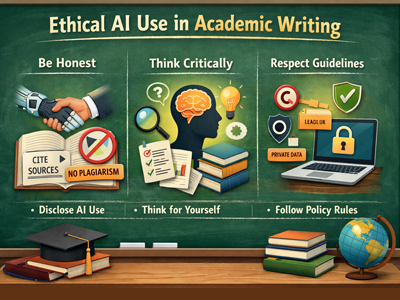

The use of AI tools has fundamentally changed the nature of academic work. Increasingly, students and researchers depend on AI to generate ideas and develop content. This trend raises an urgent question: Is the use of AI in scholarly work ethically justifiable?
Answering this question requires careful consideration, but the main principle is that students must uphold the quality and credibility of their academic work in this AI era. Clear guidelines are emerging for ethical navigation, and misuse of AI tools in research is strongly discouraged. As AI technology becomes more sophisticated and permanent, maintaining academic standards is crucial.
AI Ethics in Academic Writing
There are numerous ways we can leverage AI, and here are a few use cases:
(i) Citation Management and Referencing
AI Citation tools can save time while still upholding academic standards. These apps automate formatting. By integrating them into everyday writing, researchers reduce common formatting mistakes and focus on content development. However, they should ensure these tools provide accurate references. It is always paramount to cross-check sources. AI tools sometimes “hallucinate” – producing citations that never exist, and that may land authors or researchers in trouble.
(ii) Plagiarism Detection
Plagiarism management relies on artificial intelligence, a common practice in academic writing and research. AI-powered tools, such as Turnitin, offer ethical services to scan text. The ultimate goal of these applications is to inspect similarity to existing research. In fact, original content should record the lowest probability score for similarity.
Did you know that presenting AI-generated content as your own without disclosure is a breach of academic honesty?
(iii) Idea Generation
Not everyone is a Shakespeare. Nevertheless, AI makes our work easy. It can spark ideas for research topics. These suggestions can help authors in thesis writing, dissertations, term papers, scientific journals, and more.
Still, you should treat AI thoughts as seeds for your critical evaluation. Substantial human contribution is essential in any academic work.
(iv) Text Enhancement
Humans are prone to error, and this is evident in our speech and writing. Fortunately, AI apps polish our grammar and language. Trinka Ai and Grammarly are excellent examples of such solutions –they refine academic texts.
Furthermore, artificial intelligence enhances style and clarity. To sum up, scholars should ensure their original ideas and voices remain intact while using these apps.
Why Academic Integrity Matters
When using AI in academic writing, one key thing to avoid is presenting AI-generated content as entirely your own work. After all, academic ethics rest on honesty, originality, and fairness. Additionally, you should also avoid using AI to fabricate references, citations, data, or quotations, as this undermines scholarly integrity and can spread misinformation.
Another practice to avoid is over-reliance on AI at the expense of critical thinking. AI tools should support learning, not replace analysis, argument development, or original insight. Allowing AI to structure arguments, interpret results, or draw conclusions without your own intellectual input undermines academic rigor and may lead to superficial or inaccurate work.
Finally, avoid using AI in ways that violate privacy, copyright, or institutional guidelines. Uploading sensitive research data, unpublished work, or personal information into AI systems can breach ethical and legal standards. Always ensure that your use of AI aligns with your university’s academic integrity policies and that the final work reflects responsible, informed, and human-led scholarship.
Conclusion
Academic achievements must result from legitimate effort. Concealing and submitting text produced by AI without acknowledgement constitutes academic dishonesty, especially when policies demand transparency. Some courses, however, encourage AI use if disclosed and reflected upon clearly.
Have you ever been busted for using AI unethically?