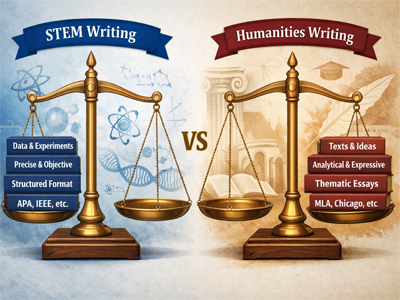

STEM writing and Humanities writing differ fundamentally in their objectives, structure, and tone. BY the way, STEM stands for Science, Technology, Engineering, and Mathematics. Whereas STEM explains, tests, or proves something, writing for the Humanities aims to interpret, argue, or critique ideas, texts, cultures, or historical events. STEM provides proof in the form of data, experiments, and reproducible methods.
Characteristics of STEM Writing vs. Humanities Writing: Key Differences Explained
a) Purpose of Writing
Overall, the goal of STEM writing is clarity and precision, while writing for the Humanities focuses on insight and persuasive reasoning.
b) Style and Language
Concise language and the use of a formal tone are the common features of STEM writing. Additionally, writers use technical terms and a passive voice. STEM writing contains minimal emotion and personal voice.
On the other hand, Humanities writing is more expressive and flexible. Authors communicate with strong authorial language and an active voice, often characterized by metaphors or rhetoric.
c) Structure
STEM writing is highly standardized. Such papers have an introduction, methods, results, and discussion sections. The headings and subheadings are also essential. Moreover, they contain tables, figures, equations, and citations.
On the contrary, Humanities are essay-driven and thematic. Rather than using a formula, their structure supports an argument. These papers rely on texts, theories, historical records, or philosophical reasoning.
d) Length and Detail
STEM papers are usually shorter (5 to 15 pages), while Humanities papers may have as many as 20 to 30+ pages. More papers mean a deep and in-depth exploration.
e) Evidence and Argumentation
Both STEM and Humanities content are evidence-based. STEM evidence encompasses experiments, datasets, simulations, and observations. Most importantly, the arguments must be reproducible and verifiable.
For the Humanities, you can provide evidence in the form of texts, theories, artworks, or historical documents.
f) Citations and Referencing
The most common styles for STEM papers are APA, IEEE, and Vancouver. However, the choice depends on discipline. Humanities writing focuses on textual analysis; therefore, MLA and Chicago are the preferred citation styles. Yet, APA also applies here. Citations support interpretations and intellectual lineage.
Read Also: How to Use AI Ethically in Academic Writing and Research
Summary: The Comparison of STEM Writing and Humanities Writing: A Student-Friendly Guide
| Goal | Explain & prove | Interpret & argue |
| Tone | Objective, precise | Analytical, expressive |
| Structure | Fixed & standardized | Flexible & thematic |
| Evidence | Data & experiments | Texts & ideas |
| Author Voice | Minimal | Prominent |
Conclusion
To sum up, students and researchers must understand their writing objectives. Their mindsets matter more than just changing vocabulary. STEM writing is highly collaborative. That is why many co-authors feature on a STEM paper.
On the contrary, writing for the Humanities often involves solitary efforts. If your research is STEM-oriented, ask yourself this question: Can we replicate this? However, the predominant question for the Humanities is: Does this interpretation deepen understanding?
Anyway, request what you would like us to help you write. Contact our professional writers and researchers.